

Many parents begin searching for answers when they notice sudden emotional or behavioral changes in their child. In families navigating PANS/PANDAS children, these shifts can feel abrupt, confusing, and completely out of character.
I didn’t start studying these patterns casually. I started because I saw them happening right in front of me.
Years ago, I began noticing something that didn’t fit the typical explanations parents were getting. Parents raising PANS/PANDAS children would often come to me describing sudden anxiety, emotional meltdowns, sleep disruption, and personality shifts that felt abrupt and completely out of character. They weren’t describing long-standing behavioral concerns. They were describing children who had been steady, capable, and emotionally balanced, and then something changed.
One mother once looked at me and said, “It was like someone flipped a switch.” I’ve heard that same sentence more times than I can count.
At first, these stories sounded isolated. But the more families I worked with, the clearer the pattern became. There was often an illness beforehand. Sometimes strep. Sometimes a virus. Occasionally something that seemed minor at the time. Then came the anxiety, the rage, the fears, the sudden clinginess. Parents were often told it was a phase, stress, or normal development. But their intuition said otherwise.
I have worked with countless families navigating these sudden shifts. What stands out most is not just the symptoms, but the look on a parent’s face when they realize they are not alone, that this pattern has a name and an explanation.
Why This Matters
I want you to know this matters because when behavior changes abruptly, it’s easy to assume defiance, personality issues, or parenting missteps. But when you understand the physiological layers involved, you respond differently. You stop seeing a “difficult child” and start seeing a nervous system under strain.
If you’re here because something in your child shifted and you can’t quite explain it, I want you to know this: you’re not imagining it. And you’re not overreacting.
There’s a reason. And there’s a path forward. Understanding PANS/PANDAS children requires looking at immune and nervous system patterns.
What PANS and PANDAS Actually Mean (Without the Overwhelm)
Understanding PANS/PANDAS Patterns
When parents first hear the terms PANS or PANDAS, they often feel intimidated. The names sound clinical and heavy. Let me simplify them for you.
PANS stands for Pediatric Acute-Onset Neuropsychiatric Syndrome. The most important word in that phrase is acute. It means sudden. Not gradual. Not slowly building over years. Sudden.
PANS describes a pattern in which a child experiences a rapid shift in emotional or behavioral functioning. This can include anxiety, obsessive thoughts, mood swings, irritability, regression, sleep disruption, or difficulty concentrating. The key feature is that the change is abrupt and clearly outside the child’s typical baseline.
PANDAS stands for Pediatric Autoimmune Neuropsychiatric Disorders Associated with Streptococcal Infections. In this case, the sudden onset of symptoms is associated specifically with a strep infection or exposure.
How PANS and PANDAS Differ
Here’s where confusion often arises. PANS is broader. It can be triggered by various stressors like infections, immune activation, inflammation, or even significant physiological strain. PANDAS is a subset of PANS tied directly to strep.
The Immune Component in PANS/PANDAS
In both cases, the child’s immune system plays a central role.
I want you to understand that these terms do not mean your child has suddenly developed a lifelong psychiatric disorder. They describe a physiological response pattern, not a personality flaw and not a character issue.
In my practice, parents often arrive unsure whether they “qualify” for the label. I gently remind them that labels are tools for understanding patterns. The more important question is this: did your child shift suddenly and dramatically in a way that feels out of context?
If the answer is yes, that matters.
Understanding these definitions helps remove fear and replace it with clarity. Once you recognize that these changes often reflect immune and nervous system stress, you begin to see that this is not random behavior.
It’s communication from the body.
National Institute of Mental Health PANDAS Overview
Pediatric Acute-onset Neuropsychiatric Syndrome (PANS) Care
The First Subtle Signs Parents Often Miss
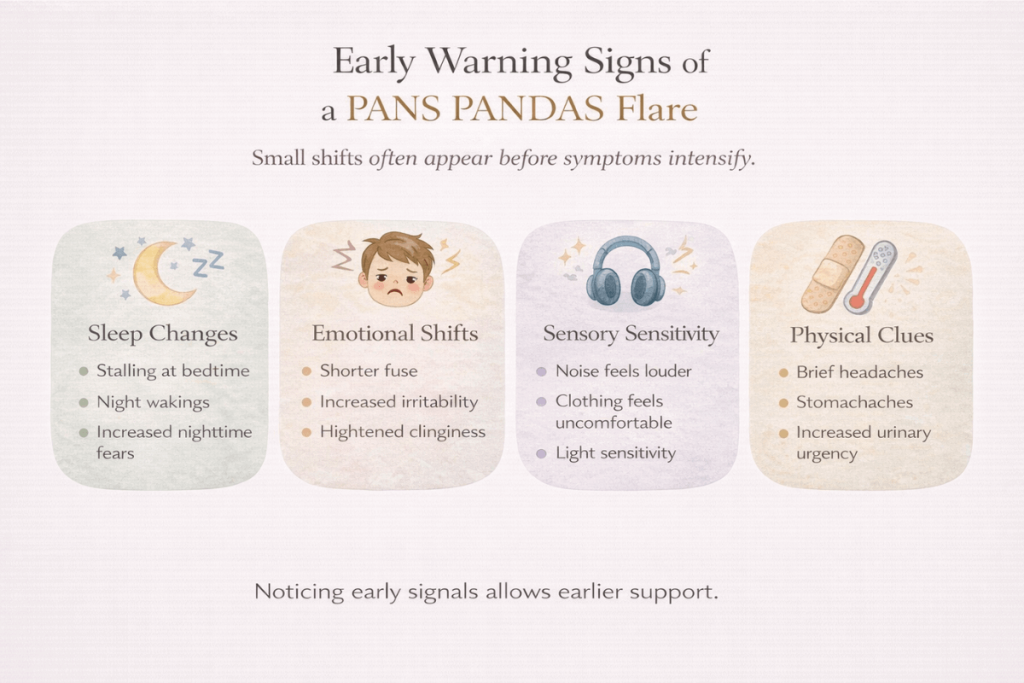
Long before a full flare, there are often whispers.
When I sit with parents and we trace the timeline backward, they almost always say, “Now that I think about it…” That sentence is usually followed by a list of small changes that didn’t seem significant at the time.
- A few nights of restless sleep
- More irritability than usual
- Sudden sensitivity to noise
- A new reluctance to separate at school drop-off
None of these alone feel alarming. But together, they begin to form a pattern.
Early Sleep Changes in PANS/PANDAS Children
Sleep is often the earliest clue. A child who normally falls asleep easily may start stalling. They may wake at 2 a.m. and crawl into your bed. They may say they feel “scared” but can’t explain why. Parents sometimes assume it’s developmental. Occasionally it is. But when sleep disruption appears suddenly alongside other subtle shifts, I pay attention.
Subtle Emotional Shifts in PANS/PANDAS Children
Irritability is another early signal. Not dramatic rage, just a shorter fuse. More snapping at siblings. More frustration over small tasks. A child who used to transition smoothly now struggles with minor changes.
Sensory Sensitivity in PANS/PANDAS Children Before a Flare
Sensory sensitivity frequently creeps in quietly. Sounds feel louder. Clothing feels scratchy. Bright lights seem overwhelming. Parents might hear, “It’s too loud,” or “It’s bothering me,” in environments that were previously fine.
Physical clues matter too.
- Brief headaches
- Intermittent stomachaches
- Increased urinary urgency without infection
These symptoms can appear before emotional symptoms fully escalate.
I see this a lot in my practice. One family I worked with noticed their son becoming mildly clingy and slightly anxious at bedtime two weeks before a major flare. At the time, it felt small. In hindsight, it was the body signaling that stress was building.
Early recognition doesn’t prevent every flare. But it gives you a head start. When you learn to notice the whispers, you can respond before the body has to shout.
And that awareness alone builds confidence.
PANS and PANDAS – symptoms beyond OCD and tics – a systematic review
Lorem Ipsum has been the industry’s standard dummy text ever since the 1500s.
Why PANS/PANDAS Children Can Seem Like a Different Child Overnight
This is the part that unsettles parents the most.
They don’t describe a slow drift. They describe a line in the sand. “Before this week, and after this week.” It feels like a switch flipped.
When we look at what’s happening physiologically, that sudden shift begins to make sense.
Rapid Immune Activation
The immune system can activate quickly. After exposure to illness or another stressor, immune cells release inflammatory messengers designed to protect the body. In most children, this response is short-lived and resolves smoothly. In some children, the response becomes amplified or prolonged.
Those inflammatory messengers don’t stay in one place. They circulate. They communicate with the brain. Certain regions of the brain, especially those involved in anxiety, impulse control, and emotional regulation, are sensitive to inflammatory changes.
When inflammation rises, regulation becomes harder.
Nervous System Overload
At the same time, the nervous system may shift into a heightened state of alert. Think of it as the body preparing for danger. Heart rate increases slightly. Muscles tighten. Stress hormones elevate. This state is protective in true emergencies. But when it becomes sustained, everyday experiences begin to feel overwhelming.
Transitions feel abrupt. Sounds feel intrusive. Small frustrations feel enormous.
The Stress Bucket Analogy in PANS/PANDAS Children
I often use a layering analogy. Imagine your child’s system as a bucket.
The “bucket” fills up with:
- Illness
- Poor sleep
- Emotional stress
- Environmental strain
When the bucket is nearly full, even a small additional stressor causes overflow.
That overflow is what parents experience as the “overnight change.”
Lorem Ipsum has been the industry’s standard dummy text ever since the 1500s.
In hindsight, we can often identify subtle shifts beforehand. But because those early signs were small, the eventual tipping point feels dramatic.
Understanding this does something super important. It shifts the narrative from “My child is acting out” to “My child’s system is overwhelmed.”
And that change in perspective changes how you respond.
How the Immune, Gut, and Nervous Systems Interact
Lorem Ipsum has been the industry’s standard dummy text ever since the 1500s.
To truly understand PANS and PANDAS patterns, we have to zoom out and look at the body as an interconnected system rather than separate parts.
The immune system, gut, and nervous system are in constant communication. When one becomes stressed, the others feel it almost immediately.
The Gut-Brain Connection in PANS/PANDAS
Many PANS/PANDAS children experience gut disruption before emotional symptoms ever escalate. This can be your first clue.
The Immune System: Protection That Can Become Overactive
The immune system’s job is defense. When it detects a virus, bacteria, toxin, or stressor, it activates. This activation includes the release of inflammatory messengers, chemicals designed to fight and repair.
In most cases, that response turns on, does its job, and turns off.
But in some children, the immune response becomes exaggerated or lingers longer than it should. Instead of resolving quickly, inflammatory signals continue circulating.
Here’s what many parents don’t realize: those inflammatory signals can influence the brain.
Research has shown that inflammation affects regions involved in mood, anxiety, and impulse control. When inflammation rises, children may experience increased irritability, heightened anxiety, intrusive thoughts, or emotional reactivity.
This doesn’t mean something is “wrong” with your child’s brain. It means the brain is responding to immune communication.
The Gut: Where Immunity and Emotion Meet
A significant portion of immune activity lives in the gut lining. The gut is not just a digestive organ. It’s an immune organ.
It also produces and regulates neurotransmitters involved in mood, including serotonin. When gut balance shifts, mood often shifts.
I hear from parents frequently that stomachaches increase before emotional symptoms escalate. Appetite changes may occur. Food sensitivities may become more noticeable.
When gut irritation increases, immune signaling often increases. When immune signaling increases, inflammation rises. And when inflammation rises, emotional regulation becomes harder.
You can see how quickly this becomes cyclical.
The Nervous System: The Sensory Filter
The nervous system determines how your child experiences the world.
When balanced, it allows flexibility. When overloaded, everything feels amplified.
In a heightened state, sounds feel louder. Lights feel brighter. Transitions feel threatening. Separation feels unsafe.
This is often called sympathetic dominance, the body’s alert mode. In this state, stress hormones remain elevated. Recovery from minor stress takes longer. Emotional flooding happens faster.
The Communication Loop
A typical flare might unfold like this:
Illness activates the immune system. Inflammatory messengers increase. Brain regions regulating mood become sensitized. The nervous system shifts into high alert. Sleep quality declines. Gut sensitivity increases. Emotional regulation decreases.
Each layer reinforces the next.
When parents understand this loop, something powerful happens. They stop viewing behavior as intentional misbehavior. They begin seeing it as physiological stress.
And that shift changes everything about how they respond.
Understanding PANS/PANDAS Flare Cycles and What Triggers Them
One of the most confusing aspects of PANS and PANDAS is the flare cycle. Parents will often tell me, “We were finally doing better, and then it all came back.” That unpredictability can feel super discouraging.
A flare is a period where symptoms intensify beyond your child’s current baseline. It can last a few days or several weeks. Sometimes it builds gradually. Other times it feels sudden.
What a PANS/PANDAS Flare Cycle Looks Like in Children
In many children, the pattern follows a rhythm. In fact, flares in PANS/PANDAS children often follow illness or stress.
- A trigger occurs
- Subtle signs appear (such as sleep shifts)
- Milk irritability
- Increased clinginess
- Emotional or behavioral symptoms intensify
- Physical symptoms arise alongside them
- Eventually, gradual stabilization begins
And the cycle repeats.
The early warning signs are usually quieter than the peak symptoms. A child may become slightly more sensitive or fatigued before anxiety or meltdowns increase.
Common Triggers for PANS/PANDAS Children
Illness is one of the most common triggers. Even a mild cold can activate the immune system enough to initiate a flare.
Lack of sleep is another major factor. A few nights of disrupted rest can significantly lower emotional resilience.
Emotional stress matters too. Transitions at school, social conflicts, travel, or even exciting events can tax an already sensitive system.
Environmental factors such as seasonal changes or increased sensory input can also contribute.
Why Flares Feel Unpredictable
Parents often ask me why one exposure causes a flare while another doesn’t. The answer usually lies in cumulative stress.
Imagine your child’s system as carrying an invisible stress load. When that load is low, small triggers may not cause much disruption. When the system is already strained, even a minor stressor can tip it over.
This layering explains why flares sometimes seem random.
Tracking Patterns in PANS/PANDAS Children
I encourage families to keep a simple record:
- Sleep quality
- Illness exposure
- Stressful events
- Emotional intensity
Over time, patterns become clearer. You may notice flares consistently follow sleep disruption or appear two weeks after illness exposure.
Tracking doesn’t eliminate flares, but it reduces fear. It replaces unpredictability with awareness. And awareness allows you to respond sooner and more calmly.
Emotional Symptoms in PANS/PANDAS Through a Nervous System Lens
Anxiety in PANS/PANDAS children can appear suddenly. When symptoms begin to escalate, it can be tempting to focus only on the behavior. The meltdowns. The refusal. The fear. The irritability. But if we pause and look beneath the surface, we often find a nervous system under significant strain.
Understanding this lens changes how you respond.
Anxiety and Intrusive Fears in PANS/PANDAS Children
Sudden anxiety is one of the most common patterns I see. A child who was once confident may suddenly become fearful of sleeping alone, going to school, or being separated from a parent.
From a nervous system perspective, this makes sense. When the body shifts into high alert, it becomes scanning and protective. The brain starts asking, “What could go wrong?” Even small uncertainties feel threatening.
Intrusive thoughts can also emerge. These are unwanted worries that feel loud and repetitive. They’re not a reflection of character. They’re a sign of an overwhelmed stress response system.
Irritability and Rage in PANS/PANDAS Children
Irritability often reflects reduced regulation capacity. When the nervous system is already activated, it takes far less stimulation to trigger an outburst.
I frequently tell parents: imagine trying to stay calm when you have a high fever. Your tolerance is lower. Your patience is thinner. That’s similar to what a child experiences during a flare.
Rage episodes can feel especially alarming. But they often represent emotional flooding, a nervous system that has exceeded its coping capacity.
Compulsions and Repetitive Behaviors
Repetitive behaviors or rituals may emerge during flares. These behaviors often provide predictability in an internal environment that feels chaotic.
If the body feels unstable, routine feels stabilizing.
Social Withdrawal and Focus Changes
When regulation capacity drops, social interaction becomes exhausting. Focus requires energy. Emotional masking requires energy. Many children withdraw simply because their system is depleted.
From the outside, these behaviors may look defiant or oppositional. From the inside, they’re protective.
When you see behavior as communication rather than resistance, your approach softens. And that softness helps the nervous system settle.
Gentle Home Supports for PANS/PANDAS
When everything feels intense, parents often ask me, “What can I do right now?” While every child is different, there are foundational supports that consistently make a difference because they lower overall nervous system load.
None of these replace individualized care. But they create a steadier environment while your child’s system recalibrates.
Create Predictable Rhythms
The nervous system thrives on predictability. When a child knows what’s coming next, their body can relax slightly.
Consistent wake times. Regular meal timing. A calming, repetitive bedtime routine.
Even something as simple as reviewing the next day’s plan each evening can reduce anticipatory anxiety.
I’ve seen dramatic improvements simply from stabilizing bedtime. Earlier lights-out. Lower stimulation. Same sequence every night. It sounds basic, but believe me when I say it matters deeply.
Soften Sensory Input
If your child is overwhelmed, reduce incoming stimulation where possible.
Dim evening lighting. Lower background noise. Offer noise-canceling headphones in busy environments. Create a quiet corner where they can decompress.
During flares, push less. Shorten outings. Say no more often. Protect energy.
Simplify Transitions
Sudden transitions can feel jarring to an activated nervous system.
Give five-minute warnings. Use visual schedules. Preview changes before they happen.
This creates a sense of safety and predictability.
Prioritize Rest
Sleep repair is foundational. Even if sleep is disrupted, protect wind-down time. Limit screens in the evening. Keep the bedroom calm and cool.
Support Nervous System Balance
Tools like the Calm Patch may be supportive during seasons of overwhelm, fear, irritability, or emotional escalation. Many parents have shared with me that it helps take the edge off and lowers intensity during flares.
For families wanting additional gentle support during difficult seasons, the PANS/PANDAS Support Kit was created to offer steady nervous system and immune support at home.
Small, consistent shifts compound. You don’t need to fix everything overnight. Lower the overall stress load, and the system often begins to soften.
Supporting Siblings During a Flare
Lorem Ipsum has been the industry’s standard dummy text ever since the 1500s.
When one child is in a flare, the entire household feels it.
How Flares Affect Siblings
Siblings often witness the anxiety, the meltdowns, the sudden fears, or the emotional intensity without fully understanding what’s happening. They may feel confused, frustrated, scared, or even resentful. And because so much attention naturally shifts toward the child in distress, siblings can quietly begin carrying their own stress.
I’ve worked with families where siblings start tiptoeing around the house. They become hyperaware of triggers. They learn what not to say. Some become protective. Others withdraw. Occasionally, they act out themselves, not because they’re misbehaving, but because their nervous systems are absorbing the tension.
I want you to know that siblings experience the flare too.
Explaining PANS/PANDAS to Siblings in Simple Terms
One of the most helpful steps is offering age-appropriate explanation. You don’t need complicated language. Something simple and honest works best:
“Your brother’s body is feeling overwhelmed right now. When his body feels overwhelmed, his emotions get bigger. He isn’t trying to be mean. We’re helping his body calm down.”
This removes blame. It protects relationship.
Creating Safety for Siblings
Carve out small moments of one-on-one time with siblings, even if brief. Ten minutes of undivided attention can reassure them that they’re still seen. Consistency matters more than duration.
Also protect their nervous systems. If a flare escalates into a loud meltdown, calmly guide siblings to another room. Offer headphones if needed. Reassure them that the intensity will pass.
Encourage siblings to share their feelings. Some may admit they feel angry. Others may say they feel worried. Normalize both. Their experience is real too.
Making Space for Their Emotions
I see this repeatedly: when siblings feel informed and included, family tension softens. When they feel confused or overlooked, strain increases.
Supporting siblings isn’t about dividing your energy evenly in every moment. It’s about acknowledging that everyone is adjusting.
And when the whole family feels steadier, the child in flare often begins to settle more quickly as well.
Advocating for a Child with PANS/PANDAS at School
For many families, school becomes the hardest environment during a flare.
At home, you can adjust lighting, reduce noise, soften expectations, and offer reassurance. In a classroom, those variables multiply. Bright lights. Social pressure. Transitions every 45 minutes. Academic demands layered on top of emotional strain.
When a child in flare walks into that environment, their nervous system may already be on high alert.
Inflammation can affect concentration and processing speed. A child who previously completed assignments easily may now struggle to focus. Directions feel overwhelming. Multi-step tasks feel impossible. Even lining up for recess can trigger anxiety.
Teachers often see the behavior before they understand the physiology.
This is where advocacy becomes super important.
Practical School Accommodations
Lorem Ipsum has been the industry’s standard dummy text ever since the 1500s.
Start by framing the situation medically rather than behaviorally. You might say, “We’re working through a medical pattern that affects regulation and anxiety. You may notice fluctuations in focus or emotional tolerance.”
That wording shifts the lens.
Practical accommodations can make a significant difference
- Flexible deadlines during flares
- Reduced homework load temporarily
- Access to a quiet space
- Permission for short movement breaks
- Gentle transition warnings
- Seating in a lower-stimulation area
You don’t need to demand everything at once. Start with what feels most urgent.
Some families pursue 504 plans or other formal accommodations. While each school system differs, having documentation that acknowledges medical impact can provide protection and clarity.
I often remind parents that teachers want children to succeed. Many simply don’t understand what they’re seeing. Clear communication builds partnership.
It can also help to share patterns. “We’ve noticed symptoms intensify after illness exposure” or “Sleep disruption tends to affect her focus significantly.”
When schools feel informed rather than surprised, collaboration improves.
Advocacy doesn’t require confrontation. It requires clarity and steadiness.
And when school becomes a little more flexible, the overall stress load decreases, which often reduces flare intensity at home as well.
The Emotional Toll of PANS/PANDAS on Parents (And Why It Matters)
There’s something few people talk about openly: how exhausting this is for you.
When your child changes suddenly, you don’t just adjust your schedule. You adjust your nervous system.
Parents navigating PANS or PANDAS patterns often become hyper-vigilant. You start scanning for early signs. Then you analyze sleep patterns. Next, you replay conversations. You brace yourself before transitions. Sadly, you may feel like you’re always waiting for the next flare.
That constant alertness takes a toll.
The Hidden Stress You Carry as a Parent of a PANS/PANDAS Child
I’ve seen marriages strain under the weight of unpredictability. One parent may feel urgent and protective, the other may struggle to understand the intensity. Extended family may offer opinions without understanding the physiological layer beneath the behavior. It can feel super isolating.
Guilt often creeps in too. “Did I miss something?” “Did I cause this?” “Am I doing enough?”
Let me say this clearly: you did not cause this.
Your steadiness matters more than perfection.
There’s also something important about nervous system mirroring. Children, especially during flares, are highly sensitive to parental regulation. When you’re constantly bracing, they feel it. When you soften, even slightly, they feel that too.
How Your Emotional Regulation Impacts Your Child
This doesn’t mean you must be calm all the time. It means small shifts in your own regulation ripple outward.
Practical support for parents can be surprisingly simple:
Build micro-moments of reset into your day Step outside for fresh air after intense moments Ask for help when possible Lower expectations during flares
You don’t have to solve everything at once.
One of the most powerful shifts I see in families happens when parents stop fighting the flare and start stabilizing the environment around it. When your nervous system becomes less reactive, your child’s system often begins to follow.
You matter in this equation.
And supporting yourself isn’t selfish. It’s therapeutic for the entire family.
What Recovery Actually Looks Like
One of the hardest parts of navigating PANS and PANDAS is not knowing what “better” is supposed to look like.
Parents often ask me, “How will I know we’re improving?” They expect a dramatic shift, a clear moment where everything returns to normal. In reality, recovery is usually quieter and more gradual.
Recovery in PANS/PANDAS is rarely dramatic; it usually unfolds in steady, layered improvements over time.
Early Signs of Improvement
Sleep often improves first. Bedtime resistance softens. Night wakings decrease. A child who needed constant reassurance may begin falling asleep more independently again.
Next, emotional intensity begins to lower. Outbursts become shorter. Anxiety feels less constant. Transitions may still be hard, but they’re not explosive.
Then comes resilience. A disappointment that once caused a meltdown now causes frustration and recovery. School days become more consistent. Social tolerance improves.
Progress is rarely perfectly linear. There may still be flares during illness or stress. But the baseline changes. The child doesn’t fall as far, and they recover more quickly.
Why Progress Isn’t Linear
In my practice, I often tell parents to watch for “glimmers.” A spontaneous laugh. A flexible moment. A day that feels almost normal. Those glimmers aren’t accidents. They’re signs the nervous system is recalibrating.
Over time, flare frequency typically decreases. Duration shortens. Intensity lowers.
What I consistently see is this: when the immune load decreases and the nervous system feels safer, children regain the qualities that always belonged to them.
Confidence returns gradually. Humor comes back. Independence rebuilds.
Healing doesn’t erase the memory of the hard season. But it does restore steadiness.
And when that steadiness returns, it feels unmistakable.
Building Resilience After PANS/PANDAS Flares
Once symptoms begin to stabilize, many parents feel a mix of relief and anxiety. Relief that things are calmer. Anxiety that another flare could be around the corner.
This is a super normal phase.
After an intense season, it takes time for everyone’s nervous system to trust stability again. Parents may find themselves watching closely for subtle shifts. Children may remain slightly cautious, even as they improve.
This is where resilience building becomes important.
What Resilience Really Means After a Flare
Resilience isn’t about preventing every future flare. It’s about strengthening the body’s recovery capacity.
One foundational piece is maintaining consistent rhythms even when things feel better. It can be tempting to relax bedtime or overload schedules once symptoms improve. But steady sleep, predictable routines, and balanced transitions continue to protect the nervous system.
Protecting Rhythms and Routine
Nutrition and digestion often play a quiet but meaningful role. When digestion is supported and meals are consistent, energy stabilizes. Stable energy supports emotional steadiness. I often remind families that simple consistency can be more powerful than complexity.
Movement and Nervous System Regulation
Movement also matters. Gentle outdoor time, walking, or unstructured play help discharge residual stress from the nervous system. The goal isn’t intense activity but regulation.
Rebuilding Independence Gradually
Equally important is gradually rebuilding independence. If a child became highly dependent during a flare, recovery includes gently expanding comfort zones again.
Small wins matter:
- Sleeping independently for part of the night
- Attending a shortened social activity
- Completing schoolwork with support and then gradually without it
These steps should feel scaffolded, not forced.
Watching Resilience Take Root
I encourage families to celebrate progress openly. Acknowledge improvements. Name the resilience. This reinforces safety internally.
Over time, you may notice that flares, if they occur, are shorter and less intense. Recovery happens faster. Emotional flexibility increases.
That’s resilience taking root.
Healing isn’t about returning to a previous version of your child exactly as they were. It’s about emerging with stronger regulatory capacity.
And when that happens, confidence quietly rebuilds in both you and your child.
Over time, many families notice that PANS/PANDAS flares become shorter and less intense as overall stress load decreases.
When Extended Family and Friends Don’t Understand
One of the quiet stressors many parents carry is navigating outside opinions. Because PANS/PANDAS can fluctuate, others may not always understand why one week looks stable and the next feels overwhelming.
From the outside, PANS and PANDAS patterns can look like behavioral issues, inconsistent discipline, or anxiety that “should be pushed through.” Well-meaning relatives may say things like, “They just need firmer boundaries,” or “It’s probably a phase.” Friends may wonder why plans are canceled at the last minute.
If you’ve experienced this, I want you to know you’re not alone.
Why Others Misread PANS/PANDAS
Because these patterns fluctuate, others may see your child on a “good day” and assume everything is fine. They don’t see the layered buildup, the disrupted sleep, or the internal overwhelm that preceded that moment.
This is where clarity and confidence matter.
A Simple Script That Protects Your Energy
You don’t owe everyone a detailed explanation. But having a simple script can protect your energy:
“We’re navigating a medical pattern that affects regulation and anxiety. Some days are easier than others. We’re supporting it carefully.”
That statement sets a boundary without inviting debate.
Protecting Your Nervous System
It can also help to identify one or two safe people who understand the deeper picture. A friend who can listen without minimizing. A relative who can step in for an hour without judgment. Support doesn’t need to be large; it needs to be steady.
There may be moments where you choose not to engage in correction at all. Not every comment deserves your emotional energy. Protecting your nervous system protects your child’s.
Letting Go of the Need to Convince
Over time, as symptoms stabilize, many families find that extended circles relax as well. But during intense seasons, it’s okay to narrow your focus.
Your responsibility isn’t to convince everyone. It’s to support your child.
And when you feel confident in your understanding of what’s happening physiologically, outside opinions carry less weight.
Trust what you’ve observed. You know what you’ve experienced. And you can also trust the improvements you’ve seen.
That quiet confidence becomes another stabilizing force in your home.
When It’s Time for Deeper Support
There are seasons when home adjustments are enough to steady the ship. And there are seasons when you can feel that something more structured is needed.
When PANS/PANDAS symptoms persist or cycle frequently, individualized support can help address the underlying layers contributing to the pattern.
When Home Support Isn’t Enough
If flares are returning frequently, if symptoms are significantly interfering with daily life, or if you feel stuck and unsure how to move forward, deeper individualized support can make a meaningful difference.
Why Individualized Support Matters
I understand that feeling of not knowing what else to do. I’ve been there myself, remember? When I was in the middle of my own health crisis with panic attacks and heart issues, I felt completely lost. That’s why I’m so committed to helping families find their way through this.
What a Chronic Consult Involves
A chronic consult isn’t a quick symptom-based visit. It’s a comprehensive look at your child’s full timeline.
We discuss:
- Illness history
- Emotional shifts when they begin
- Sleep patterns
- Digestive patterns
- Flare cycles
- Stress triggers
- Enviornmental exposures
- And much, much more…
We work to get a clear picture of what’s happening.
When you understand terrain, you respond more precisely. I see this all the time in my practice. Parents want to finally feel like someone is listening and connecting the dots.
How Bio Resonance Works
Bio resonance is a gentle, non-invasive assessment tool that evaluates how the body is responding to stressors and support options. The premise is that the body communicates through measurable frequency patterns. When strain is present, those patterns shift.
Through scanning, we can identify areas that may need support like immune stress, nervous system overload, digestive imbalance and prioritize accordingly.
This is actually how I finally unlocked the mystery of my own SVT. The bio resonance scan showed the infection disresonance in my wisdom tooth, and suddenly everything made sense. I was able to get to the root cause instead of just managing symptoms.
Parents often appreciate that this process is individualized and layered rather than one-size-fits-all.
What You Can Expect From the Process
Progress typically unfolds in stages.
Sleep may stabilize first. Emotional intensity may soften next. Transitions may become smoother.
Improvement is rarely perfectly linear. Small flares can still occur, especially during illness or stress. But over time, baseline resilience strengthens.
Perhaps most importantly, parents begin to feel steadier. And when you feel steadier, your child’s nervous system often responds to that stability.
Support isn’t about urgency. It’s about guidance and consistency.
You don’t have to navigate this alone. I’m here to help you figure this out, just like I had to figure out my own health journey.
Your Child Is Still There
When you’re in the middle of a flare, it can feel like everything familiar has disappeared. The child who once laughed easily now seems anxious. School becomes more challenging. Every day tasks seem paramount. Suddenly, the child who moved through life with steadiness now feels fragile or reactive.
It’s deeply unsettling. I understand that completely.
But I want to say this clearly: your child is still there.
Rebuilding Confidence After a Flare
Underneath the anxiety, the irritability, the meltdowns, and the fears is the same nervous system that once felt steady. It’s simply overwhelmed right now. When inflammation settles, when sleep stabilizes, when stress load decreases, you often begin to see glimpses of that steadiness returning.
I’ve watched this happen over and over again. I’ve seen it in hundreds of families.
First, a slightly calmer bedtime. Then fewer outbursts. Next, a week where school feels manageable again. Then laughter that sounds like it used to.
It rarely happens in one dramatic moment. It happens gradually. Quietly. Layer by layer.
Parents often tell me, “I forgot what it felt like to see them relaxed.” And then one day, they notice it. Their child playing comfortably, transitioning without tears, handling disappointment with more flexibility.
That’s resilience rebuilding.
This season may test your patience and your confidence. It may stretch you in ways you never expected. But it doesn’t define your child, and it doesn’t define your family.
When you understand what’s happening beneath the surface, fear softens. When fear softens, steadiness grows.
And when steadiness grows, healing follows.
You’re not imagining the shift you saw. You’re not alone in navigating it. And with the right support, your child can find their way back to balance.
Take heart. Hold on to that.
What I Want Every Parent to Remember
Living through PANS/PANDAS stretches a family, but it also builds awareness, steadiness, and resilience that lasts beyond the flare.
Truth #1: Sudden Change Is Information
After years of walking alongside families navigating PANS and PANDAS patterns, there are a few truths I return to again and again. I want to share them with you because they matter.
First, sudden behavioral change is information. It’s not random, and it’s not personal. When a child shifts abruptly, the body is communicating that something is under strain. I’ve learned this from my own journey with panic attacks and heart issues. My body wasn’t broken. It was trying to tell me something.
Truth #2: Regulation Capacity Fluctuates
Second, regulation capacity fluctuates. During flares, your child’s ability to tolerate frustration, transition smoothly, or manage big feelings decreases. That doesn’t mean they’ve lost those skills permanently. It means their system is overloaded in that moment. I know how scary that feels, but believe me when I say it’s temporary.
Truth #3: Steadiness Compounds
Third, steadiness compounds. Small consistent supports like sleep protection, predictable rhythms, sensory softening may not feel dramatic, but over weeks and months they lower overall stress load. And lowered stress load creates space for healing. I’ve seen this work in my own life and in the lives of hundreds of families I’ve worked with.
Truth #4: Progress Is Often Quiet
Fourth, progress is rarely loud. It often appears in subtle ways:
- Shorter meltdowns
- More flexible mornings
- Improved eye contact
- Longer stretches of restful sleep
These shifts matter. I want you to really hear that. They matter deeply.
Truth #5: This Season Does Not Define the Future
Finally, this season doesn’t define your child’s future. I’ve seen children move from intense flares to steady functioning. I’ve watched families rebuild confidence after months of uncertainty. I lived through my own health crisis that felt impossible, and I came out the other side. You can too.
Please remember that you don’t have to solve everything in one week. You don’t need to respond perfectly in every moment. Consistency is far more important.
When you understand what’s happening beneath the surface, fear gives way to clarity. When clarity grows, your nervous system steadies. And when your nervous system steadies, your child feels it.
That ripple effect is powerful.
If you take nothing else from this guide, let it be this: your child isn’t broken. Their body is responding to stress. With layered support, resilience can return.
And you’re capable of walking this path with steadiness, even when it feels overwhelming.
I’ve seen it happen. I’ve lived it myself. And I know you can do this.
You’ve got this.
DISCLAIMER:
The information provided in this article is for educational purposes only and is not intended to diagnose, treat, cure, or prevent any disease. This content does not constitute medical advice and should not replace consultation with a qualified healthcare provider. Always consult with your child’s pediatrician or healthcare professional before making any changes to their care, treatment, or supplementation. Individual results may vary.